Table of Contents
DEVELOPMENT LOG | June 21, 2026
Alright. Two weeks ago, we released the Beyond The Hearth TTRPG Dev Update article for the Archetypes – the player characters – and now it’s time for the bad guys.
The past two weeks were a lot of work, but after our playtest session yesterday, I can happily say that it was all worth it. Countless nights of trying to figure out the math behind how we wanted the encounter system to work are finally paying off.
Designing Encounters With Game Masters in Mind
Before we get to foe design, let’s quickly go over how we wanted to design the encounter system with Game Masters in mind.
Over the course of a campaign, you have multiple different scenarios where you have to prepare combat. Sometimes you can plan ahead, and sometimes you have to stomp something out of the ground in mere minutes. The latter can happen when the party completely derails the story – like that would ever happen 🙃 – or when they have to fight wild beasts, or something similar, while travelling through the lands beyond the hearth. See what I did there, ehh?
In other systems we’ve tested, the first option is usually pretty feasible. You come up with a difficulty like normal or deadly, choose one or two enemies, do some math, and you’re ready to go. But choosing those enemies sometimes comes at the cost of the story. You can’t use the monster yet because it’s too strong, or you don’t want to overwhelm your players with a boring “dozen minions” encounter. Or maybe that day a player didn’t show up and you have to rebalance everything – been there, done that. It sucks!
So I wanted to create a system where you could choose pretty much any enemy for any level, as long as it fits your story, and then vibe design the battle from there.
So we tried to figure out a formula for Threat Rating: the threat each creature brings to the battle.
What Is Threat Rating?
Threat in a combat is based on three main factors:
- The damage per round creatures deal
- Their HP, which convert to damage over the combat
- And their stat array, with things like Defence and Attack Modifier, increasing or decreasing their likelihood of dealing damage.
We then had to figure out how to scale all three of those variables without creating a massive math hassle for the Narrator – our system name for the Game or Dungeon Master – because they should be able to build an encounter on the fly, remember?
Player doesn’t show up? Need a roaming encounter? Cool, it’s done.
So we built a design document and a calculator to design foes, making their numbers coherent across all levels, roles, and ranks. This means that pretty much every creature in the Bestiary can be used from level 1 all the way to our max level of 12, without the balancing falling apart.
You could take a level 9 necromancer and 30 level 2 zombies without any problems, as long as their combined Threat Rating equals what the players can handle at your planned difficulty.
But Jonas, doesn’t that mean that every foe feels the same and gets boring after three combats? No, because we did the following:
Roles & Ranks
The first thing we did was add modifiers that distribute a foe’s Threat throughout its kit, based on its role.
For example, an Ambusher gets more damage per round, but has less HP. It hits hard, creates pressure, and rewards the players for dealing with it quickly. A Protector, on the other hand, brings more staying power to the table and can protect more fragile enemies.
Controllers and Supporters get additional, well, controlling and supporting abilities, while losing HP and Damage in return. This means you can actually focus the backline as a Sorcerer, or assassinate them as an Outlaw the sneaky way.
And the Narrator has to actually protect their Supporters and Controllers, just like the players have to protect theirs.
That was important to us. We didn’t want foes to only be different stat blocks with slightly different numbers. Their role should immediately tell the Narrator what they are meant to do in the fight. An Ambusher should feel dangerous if ignored. A Protector should be annoying to get around. A Supporter should make the whole enemy side stronger until someone deals with them.
This also helps the Narrator build encounters faster. Instead of asking, “Which monster has the exact numbers I need?”, they can ask, “What does this encounter need to feel right?” More pressure? Add an Ambusher. More staying power? Add a Protector. More tactical problems? Add a Controller or Supporter.
The role shapes how Threat is spent.
The rank then defines how each type of foe plays at the table. For now, we settled on four ranks.
Minions
Minions together strong.
They come in groups of four, can stack together up to 16 in one group, and act as one creature, usually just once per round. This makes tracking and playing them way snappier at the table, because the Narrator doesn’t have to move, attack, and track HP for every tiny creature individually.
When Minions hit certain HP thresholds, singular entities in the group die, and their damage per round decreases as well. So the group naturally becomes less dangerous as players cut through it.
Minions also take more damage from AoE abilities, and single-target attacks bleed over onto the next target if they kill the first one. This means you could slash through multiple minions with one powerful attack without the fear of wasting damage.
Because honestly, nothing feels worse than dealing 20 damage to something with 1 HP left and watching the remaining 19 damage evaporate into the void.
With Minions, we wanted players to feel powerful. They should be able to clear groups, break enemy lines, and create those heroic moments where one good swing or spell changes the whole battlefield. But they should also be dangerous through their sheer quantity, if not dealt with.
Underlings
A single Underling is as strong as four Minions, so one or two of them together can usually challenge a player.
They are the bread-and-butter foes of many encounters. Strong enough to matter, simple enough to run quickly, and flexible enough to appear in almost any battle setup.
Underlings are great when you want the players to have clear individual threats to deal with. One player might duel an Underling while another clears Minions, while the caster tries to shut down a Controller in the backline.
They are not meant to completely dominate the fight on their own, but they should never feel irrelevant either.
Elites
Elites are strong and more complex foes.
Most often, one or two players have to work together to single out an Elite and bring it down. They are dangerous enough that ignoring them can quickly become a problem, but not so overwhelming that the whole party has to focus them from round one.
Many Elites also have features that rally their Underlings or Minions. So it makes sense to split them from their servants, break their formation, or shut them down before they can fully enable the rest of the encounter.
This creates a nice tactical layer. Players can decide whether they want to burn through the smaller enemies first, isolate the Elite, or disrupt whatever synergy the enemy group is built around.
For the Narrator, Elites are the perfect tool when you want an encounter to have a clear centrepiece without turning it into a full boss fight.
Bosses
A Boss is usually a solo encounter, or comes with an Elite or a few Underlings.
Players really have to merge their powers to strike them down bit by bit. A Boss is not just a bigger pile of HP and damage. At least, that would be the boring version.
Bosses have a bigger kit to deal with the players, and phases, which bring variety to combat by changing their playstyle, their abilities, or even the environment. A beast might become more aggressive once wounded. A necromancer might start sacrificing their own minions to summon a large badass. A corrupted spirit might twist how time works on the battlefield, forcing players to reposition and rethink their strategy.
This keeps longer fights from becoming static. The players should not be able to solve the whole encounter in round one and then simply repeat the same actions until the Boss falls over.
A good Boss should feel like a story moment. It should pressure the whole party, give everyone something meaningful to do, and create those “oh no” moments when the fight suddenly changes and another player can shine with their abilities.
And yes, no matter which combination of Roles and Ranks the Narrator chooses at the end of the day, he should absolutely enjoy that part just as much, as the players.
Letting the Narrator Go All In
Concerning encounter balancing and foe design specifically, we wanted to make sure that the Narrator isn’t just there to entertain the group.
If the balancing works correctly, they can literally go all in and try to wipe the floor with their players in an easy or even deadly encounter, knowing for sure that the players will have plenty of tools to work against their cool creatures. And in the case of a deadly encounter, they will always have time to escape alive if they recognise when they are overpowered.
Beyond the Hearth is still a game focused on narrative, but also on tactical strategy. So players shouldn’t be one-shot without counterplay and lose their character, but if they play badly for multiple rounds, or just have a really unlucky dice day – we’ve all been there – they may have to run away, make a new plan, and come back prepared.
More story material. Easy.
Foes That Are Easy to Run, But Still Fun to Master
In our foe design we made sure that the Narrator, even if it’s their first time playing Beyond the Hearth – or any TTRPG, actually – isn’t overwhelmed.
Our foes all have cool abilities and sometimes cross-interactions, just like the player characters, but we made sure that even if you have five different foes on the field, you can focus on the action instead of poring over stat sheets and ability descriptions.
This, of course, also means that a single powerful boss can have more abilities for you to play around with. Any combat you choose – be it a single boss, multiple elites, a boss and minions, or whatever else – will be both rewarding to play and rewarding to play against.
Gloom: The Narrator’s Meta Currency
Oh, and the Narrator has a meta currency, just like the players.
With Gloom, they can have their unfair moments while petting their bald cat, of course already accounted for in the Threat Rating. So go spend your hard-earned Gloom to summon more zombies from the ground beneath your players’ feet, activate your foe’s ultimate, create a landslide, or suddenly change the weather to a deep fog, forcing players into close range.
Also, the feeling of being a player and seeing the Gloom increasing on the Narrator’s screen is both dreadful and fun, because you know for sure that something bad – but fair – will happen soon.
Building Encounters With Two Simple Variables
After building the first foes, we had to built an encounter formula that’s not just easy in a digital tool, but would work just as simple with a rulebook and a piece of paper.
So we focused on two simple variables for the Narrator to change.
You can change the difficulty of a battle by
- adjusting the enemies HP,
- or by changing their Threat Rating to make them deal less or more damage.
Basically, it works like this, and I love how easy it is now:
The sum of your players’ HP, including their companions if there are any, and NPCs participating in the fight, equals your Threat Rating 5 to 1.
Let’s say you have a level 1 party consisting of
- a Berserker of the Beast with 24 HP,
- a Bloomwarden Verdant with 16 HP,
- an Elementalist Sorcerer with 12 HP,
- and an Oathsworn of the Forge with 20 HP.
That gives you a sum of 72 HP.
Now you just divide it by 5. And yes, it will always be 5. Because that’s what our system document says after all the math.
So you get a Threat Rating of around 14 for the party. Now you can buy any amount of monsters that together have a Threat Rating of 14 to create a normal combat encounter, which means your party should be reduced to around 40% HP.
You want it to be more difficult? Add a bit more Threat Rating to the encounter if you want it to be snappy and hard, or increase the HP of all monsters through a simple referencing table, if you want it to be more draggy and hard. And of course, you can play with both variables.
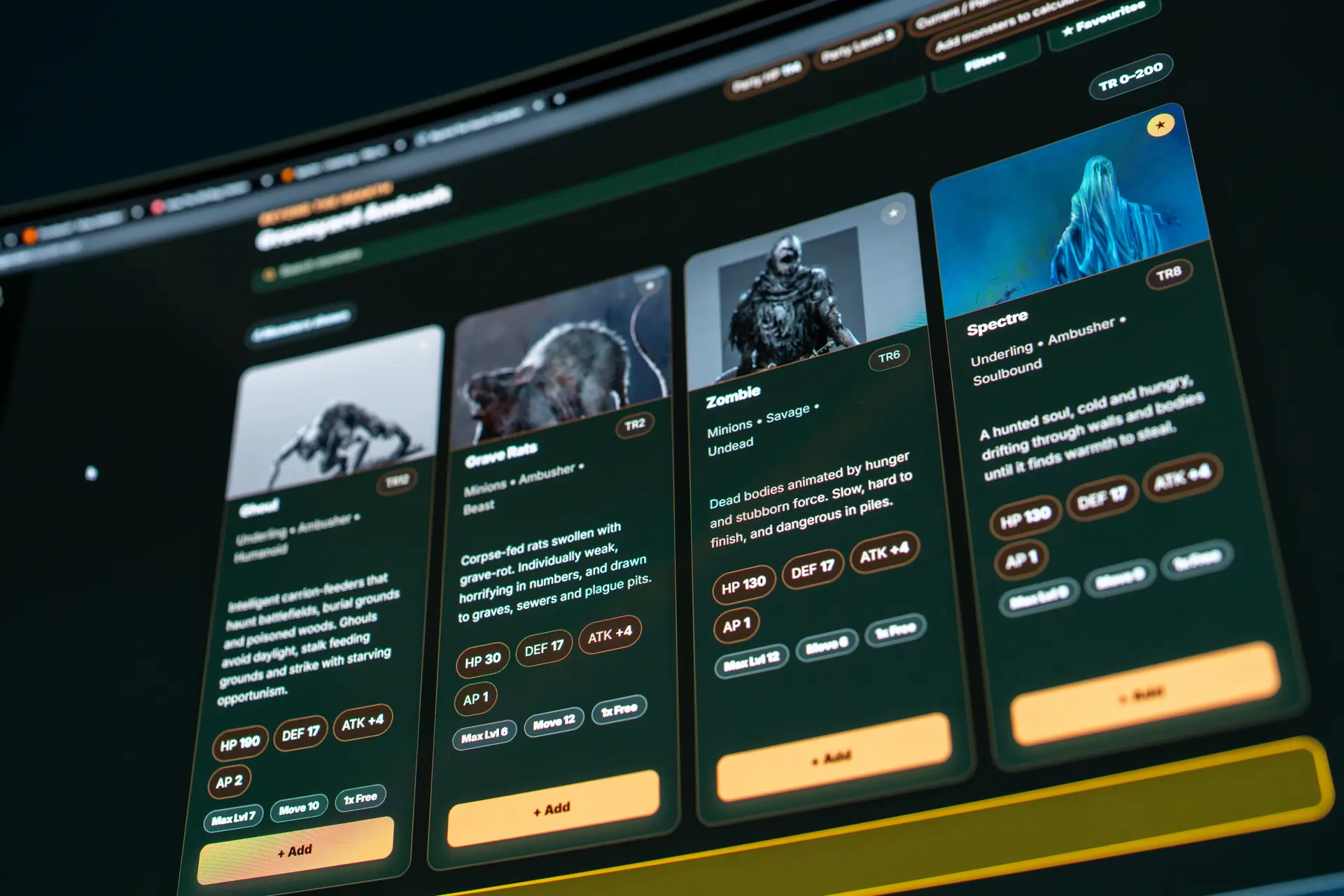
If you are using the book or .pdf once it comes out, you can just look at the values in two tables and write them down. If you are one of those digital nomads, you can use our online encounter creator, which does the table-looking for you.
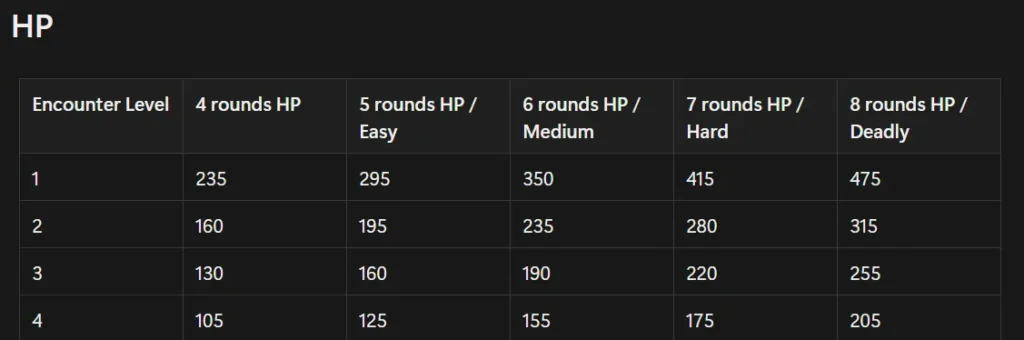
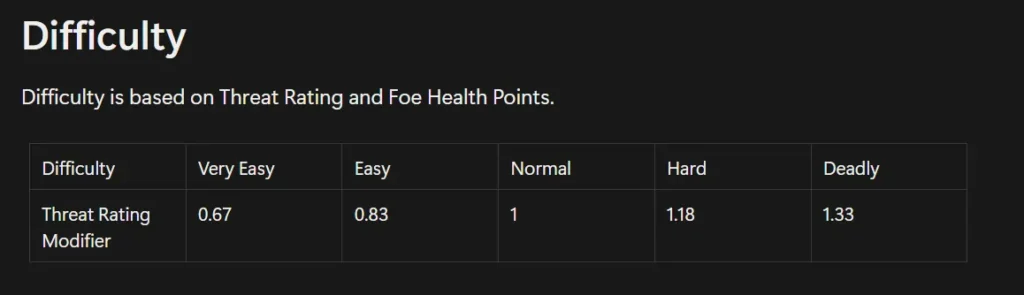
I’m currently vibe coding a quick preview/first draft of the web app encounter builder using our design documents and formulas. You can check it out here and build an encounter yourself, as soon as it’s finished.
Why We Care So Much About Balance
You might now wonder why we are so obsessed with formulas and balancing. That is exactly what one of my players asked recently: why are we so obsessed with balancing in a game that is supposed to be fun and imaginary?
My gut feeling wouldn’t be the right answer, though it did lead me down this path. So here is the logic behind all of it.
As someone who has played many unbalanced multiplayer games, both board games and computer games – looking at you, League of Legends – I think the answer is twofold.
1. Everyone Should Feel Powerful in Their Own Way
First, if we nail balance in the early development of the system, we can make sure that everyone at the table feels equal in their abilities.
Not that everyone is the same.
That would definitely destroy the fun.
But everyone should feel similar in power level within their own area of expertise.
The Sorcerer should be really good at destructive AoE spells, and therefore lack the focused single-target damage the Wildkin can bring to the table. By using clear design guidelines in everything, we can make sure that no archetype is over- or undertuned.
There are Archetypes that are strong in one or two areas, and of course we still have our jack-of-all-trades options, like some of the bards and warriors. But choosing what is in your kit automatically balances how strong each area can be. So the jack of all trades can be handy most of the time, but will never outshine a player with a specific tool in their Archetype for that situation.
2. Balance Makes Future Content Faster
The second reason is pretty egotistical. If we know our system is balanced and the numbers work, we can push out content way faster, because we “only” have to be creative, and don’t have to cross-check everything with other content we previously built.
Because we already did that. We built formulas and tables around how it properly works.
We are currently two guys doing this in the evenings beside our full-time jobs. We have to be careful where we spend our time if we really want to bring this system to life in 1–2 years’ time. And if we now spent two months making sure everything works, we will save a lot of time down the line.
Having dedicated balancing formulas will also make homebrewing a breeze. We believe that community is the most important factor for any TTRPG. So if our community can later use all this hard pre-work to create new, amazing archetypes, paths, monsters, and other content, that works in our favour as well.
What Comes Next: Projects and the Playtest
That’s it from me for today.
I’ll now have to go and build the next of the last three systems: projects. Cool off-time activities your player characters can do during rests or when they spend a few days split-screening in a city, even increasing their capabilities while doing so.
Because building your own information network should also teach you something about influencing people and give you an advantage in future social situations using our Mastery system.
Oh, and just to make sure we are all on the same page: this all sounds like a lot of stuff, but we made sure that you can ease into the systems one at a time, or even keep some of them out of your games.
So you can scale complexity from a complete beginner table with a first-time Narrator and first-time players, all the way to advanced veteran tables where people want to min-max and master the system to its deepest level.
Robin also started working on our playtest this week, which will hopefully launch in late summer. So we can finally share a first real glimpse of what we did and get your feedback!
If you don’t want to miss this opportunity – which of course will be free – you can join our ever-growing waitlist through this button.
Thank you so much for being a part of this awesome adventure.
I’ll see you next time, beyond the hearth.
Cheers,
Jonas